
Ticks are small spider-like acarids and fleas are insects, but these two tiny creatures have at least one thing in common - they are both parasites that feed on your cat’s blood and can cause a lot of discomfort and more serious health problems.
Flea bites may go unnoticed on some pets, cause slight irritation in others and produce extensive itching, red lesions, hair loss and even ulcers in those animals with flea allergy dermatitis, which is the result of extreme sensitivity to flea saliva. Severe flea infestations can cause anaemia, especially in kittens. Fleas can also transmit several diseases, as well as tapeworm. Ticks are “vectors” or carriers of a number of diseases.
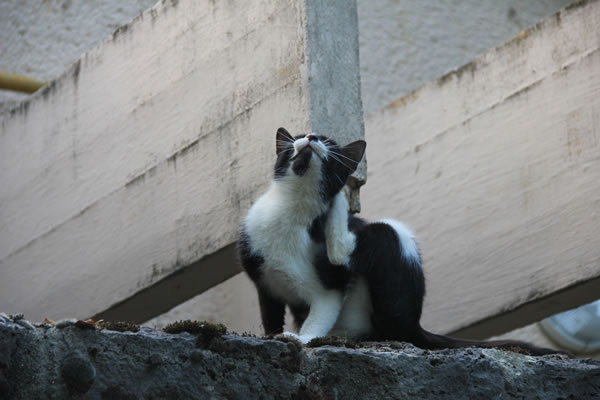
Adult fleas are wingless insects, generally smaller than a sesame seed, who feed on the blood of animals. Their proportionately enlarged back pair of legs gives them an extraordinary jumping ability. Hanging on to your pet’s fur with their claws, their needle-like mouth parts bite through the skin to suck up blood - in quantities of up to 15 times their body weight daily in the case of female cat fleas.
If one flea finds your cat an attractive food source, you can be sure that other fleas will, too! They mate, with females laying 30-50 eggs per day. These eggs will drop to the ground within 8 hours and, as soon as 2 days later, flea larvae will hatch and hide in dark places on the ground, in carpets or upholstery. After about a week of feeding on adult flea droppings, crumbs, flakes of skin, etc., the larvae spin cocoons to become pupae. The pupae can remain in this stage for very long periods of time. The cycle continues when, as soon as a week or so later, the pupae develop into adult fleas and emerge from their cocoons when they sense that a cat or dog, or another animal host, is near. The cycle - which can take as little as 12 days or as long as 180 days - can then begin again.
 You should inspect your pet regularly for ticks, especially if they have been outside in areas where there are woods or tall grasses. A thorough combing within 4 to 6 hours of exposure to such environments can help prevent ticks from attaching themselves to feast on your pet. Should you find a tick, it should be removed immediately, as the longer it is attached to its host, the greater the chance for disease. Do not touch the tick. Wear gloves and use tweezers to carefully grasp the exposed section of the tick’s body near your pet’s skin. Gently pull until the tick lets go. To dispose of the tick, wrap it in several tissues and flush it down the toilet.
If despite your best efforts at control, you find that fleas or ticks have crawled (or jumped) on board your pet, you will have to use a product that will kill and/or repel the parasites. These include once-a-month topical treatments, sprays, powders, dips, shampoos, collars and, to combat fleas, oral or injectable medication. Once again, you should ask your veterinary surgeon for advice about what the most appropriate product for your pet is. And remember, it is perfectly normal to see live fleas or ticks on a pet immediately after a topical treatment, spray, shampoo, collar, etc. is applied. Many believe that this means the product is not working, but the fleas or ticks have to fully absorb the product before they will be affected, which may take from a few hours to a few days.
- A female tick can lay up to 3,000 eggs.
- Except for eggs, ticks need a blood meal to progress to the next stage of their life cycle.
- Some ticks can live for more than a year without a meal.
- In very rare cases, toxins secreted by ticks can cause pet paralysis.
- Worldwide, there are about 3,000 different types of fleas, but the cat flea (Ctenocephalides felis) is the most common to be found on cats and dogs.
- Adult fleas can jump 600 times an hour. Each jump, in terms of the flea’s size, is the equivalent of a person clearing a 50-storey building.
- The record jump for a flea (usually 2-8 mm long) is 33 cm.
- In just 30 days, 25 adult female fleas can multiply to 250,000 fleas

How can
we Improve?
We would like to know from you what we can do to make our services even better. We invite you to make contact with us and share your ideas, we would be extremley appreciative of your feedback!

Honey bees taste with their feet.